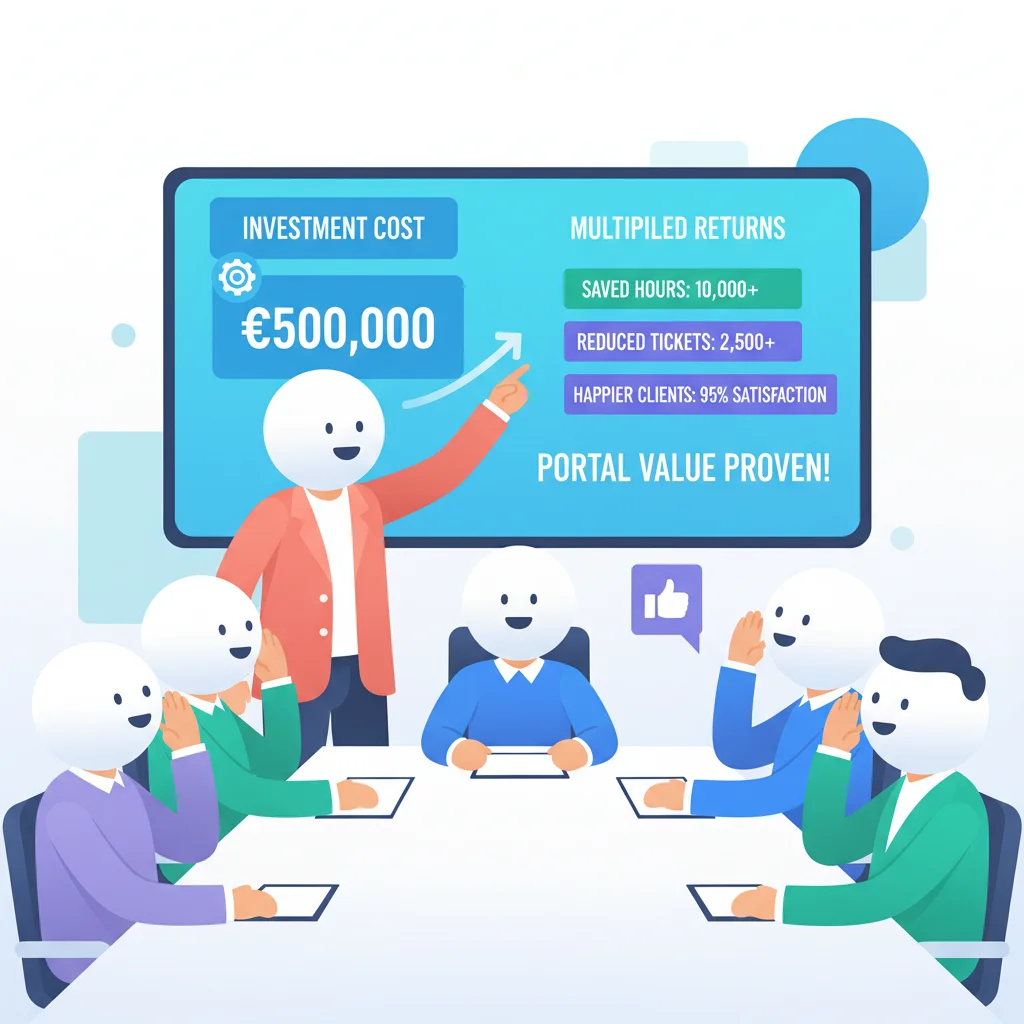
A customer portal sounds like a great idea. But your boss (or your budget) wants to see the math. Does it actually pay for itself?
For most SMBs, the answer is yes — often in under six months. Here’s the framework to prove it, with realistic numbers you can plug in for your own business.

The Cost Side
If you buy (SaaS portal platform)
- Monthly subscription: $50-500/month for most SMBs
- Setup and configuration: 10-40 hours of team time
- Content creation (knowledge base, onboarding flows): 20-60 hours
- Total first-year cost: $2,000-$15,000 for most SMBs
If you build (custom development)
- Development: $20,000-$100,000+ depending on complexity
- Ongoing maintenance: 10-20% of development cost per year
- Total first-year cost: $25,000-$120,000+
See our build vs. buy guide for a detailed comparison.
The Return Side
1. Support cost reduction
Calculation: (tickets deflected per month) × (cost per ticket) × 12
Example: If your portal deflects 100 tickets/month at $8/ticket average cost, that’s $9,600/year in support savings.
Benchmarks: Businesses typically see a 25-40% reduction in support tickets after implementing self-service portals (Gartner).
2. Reduced churn / increased retention
Calculation: (customers retained because of portal) × (average customer lifetime value)
Example: If your portal helps retain just 5 additional customers per year, each worth $2,000/year in revenue, that’s $10,000 in preserved revenue. Over their full lifetime, it’s much more.
Benchmarks: Portal users typically churn at 15-30% lower rates than non-users. See how portals reduce churn.
3. Faster onboarding
Calculation: (time saved per onboarding) × (team hourly cost) × (new customers per year)
Example: If portal onboarding saves 4 hours per client at $50/hour, and you onboard 50 clients/year, that’s $10,000 in time savings.
4. Reduced billing/collections overhead
Calculation: (time saved on billing tasks per month) × (hourly cost) × 12
Example: If self-service billing saves 10 hours/month of collections and invoice follow-up at $40/hour, that’s $4,800/year.
5. Competitive differentiation
Harder to quantify, but real: a professional, branded portal signals that your business is established and well-organized. This influences deal close rates and client referrals.
Example ROI Calculation
| Category | Annual Value |
|---|---|
| Support ticket reduction (100 tickets/mo × $8) | $9,600 |
| Reduced churn (5 customers × $2,000) | $10,000 |
| Faster onboarding (50 clients × 4 hrs × $50) | $10,000 |
| Billing/collections savings (10 hrs/mo × $40) | $4,800 |
| Total annual return | $34,400 |
| Portal cost (SaaS platform) | $5,000 |
| Net annual benefit | $29,400 |
| ROI | 588% |
Even if these estimates are cut in half, the ROI is still strongly positive.
When the ROI Is Highest
The return on a customer portal increases with:
- Customer count — More customers = more tickets deflected, more onboardings streamlined
- Transaction frequency — More frequent interactions = more self-service opportunities
- Document volume — More documents = more time saved on sharing and organizing
- Complexity of service — More complex relationships benefit more from structured portals
- Regulatory requirements — Compliance costs are high; portals reduce them