
Your front desk spends half the day confirming appointments and chasing insurance details instead of creating a great patient experience. And every empty chair from a no-show is revenue you can’t get back.
A patient portal for dental practices puts routine tasks on autopilot — digital forms, online scheduling, treatment plan reviews, and payments — so your team can focus on patient care, not paperwork.
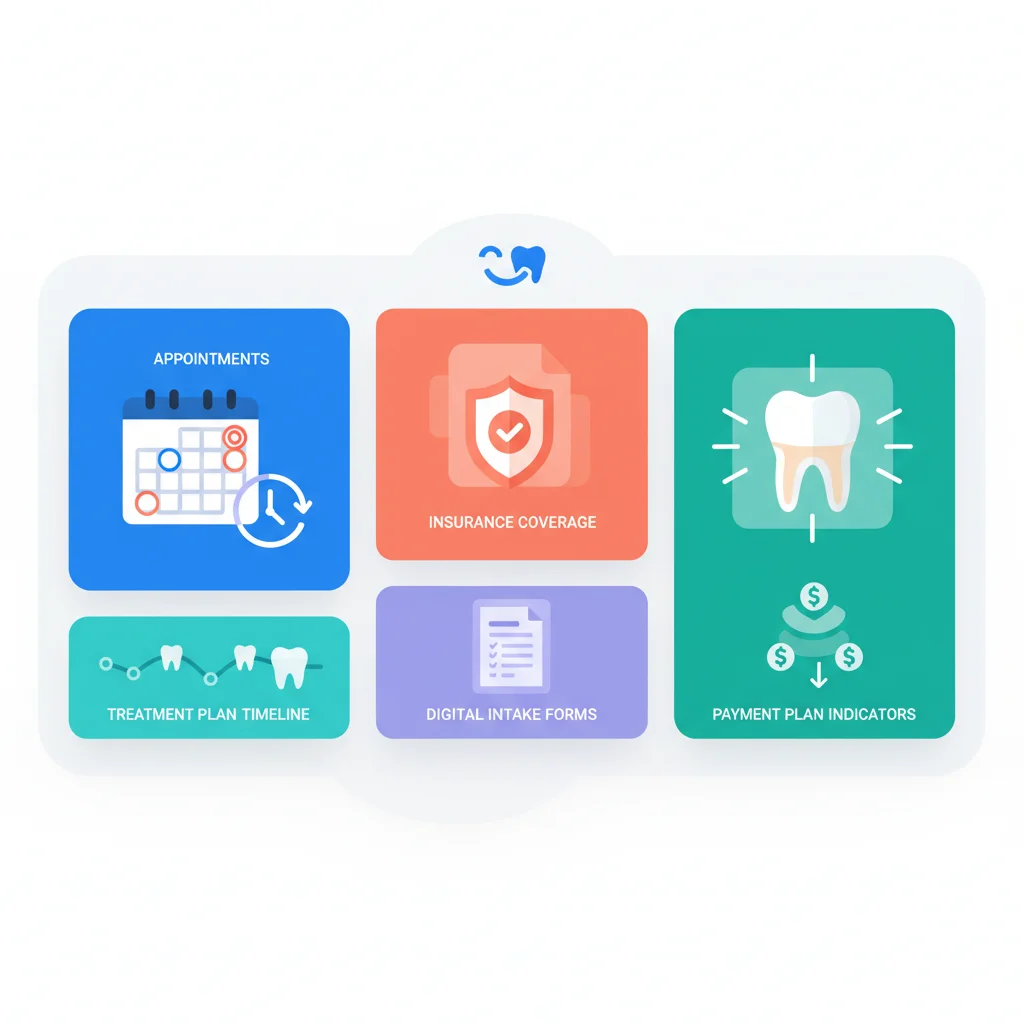
Problems a Portal Solves for Dental Practices
Appointment management consumes your front desk
Scheduling, confirming, rescheduling, and managing cancellations is the single biggest time drain for dental front office staff. Phone tag is a daily reality. Patients call during lunch when the office is closed. They forget to confirm, leading to empty chairs. They need to reschedule but don’t call until the last minute.
A portal with online scheduling lets patients book, reschedule, and cancel based on real-time availability — 24/7, not just during office hours. Automated appointment reminders via text, email, or in-app notification reduce no-shows by 25-40%. Patients confirm with a tap instead of a phone call.
For dental practices, appointment management isn’t just a convenience issue — it’s a revenue issue. Every empty chair is lost production. A portal that reduces no-shows by even a few appointments per week has a direct impact on the bottom line.
Patient intake forms are still on clipboards
The new patient experience at most dental practices starts with a clipboard. Sit down, fill out four pages of medical history, insurance information, and consent forms — by hand, in a waiting room, ten minutes before the appointment. The handwriting is illegible. Half the fields are left blank. Staff then manually enter the information into the practice management system.
Digital intake through a portal transforms this process. Patients complete forms at home, on their own time, before the appointment. The information is legible, complete (because required fields enforce it), and can flow directly into your practice management system. No manual data entry. No clipboard.
Pre-visit forms also improve clinical care. When the dentist has a complete medical history before the patient sits in the chair — including medications, allergies, and conditions that affect treatment — they can prepare more effectively.
Treatment plan acceptance is a bottleneck
Dental treatment plans — especially for complex or costly procedures like implants, crowns, orthodontics, or full-mouth rehabilitation — require patient understanding and buy-in. Presenting a treatment plan verbally in the exam room, while the patient is distracted and anxious, is not the most effective way to get acceptance.
A portal that presents treatment plans digitally — with clear descriptions, visual aids, cost breakdowns, insurance coverage estimates, and financing options — lets patients review plans at home. They can discuss with family members, compare options, and make informed decisions without feeling rushed.
Practices that provide digital treatment plan access consistently report higher case acceptance rates. When patients understand what’s recommended, why it matters, and what it will cost, they’re more likely to proceed.
Insurance verification chaos
Insurance verification is one of the most tedious aspects of dental practice management. Calling insurance companies, waiting on hold, verifying coverage levels, confirming remaining benefits, tracking annual maximums — it’s a daily grind that’s compounded by patients who don’t know their own plan details.
A portal where patients can upload insurance information — card images, plan details, employer information — before their appointment gives the front desk a head start on verification. While the portal doesn’t verify insurance automatically (that still requires interaction with the payer), having complete information ahead of time reduces verification time and eliminates the “I forgot my insurance card” scenario.
Payment collection and outstanding balances
Dental practices with high patient volumes accumulate accounts receivable quickly. Patient portions after insurance, payment plan installments, and overdue balances require follow-up — often by phone. Sending statements by mail is slow and expensive.
A portal with billing and payment capabilities lets patients view their balance, understand their charges, and pay online. Payment plans can be set up with automatic recurring charges. Statements are digital. Payment reminders are automated. The result is faster collection and lower accounts receivable.
Key Features for Dental Practice Portals
- Online appointment scheduling — Book, reschedule, and cancel with real-time availability and appointment type selection (cleaning, exam, consultation, emergency).
- Digital patient forms — Medical history, insurance information, consent forms, and HIPAA acknowledgments completed before the visit.
- Treatment plan viewer — Interactive treatment plans with procedure descriptions, cost estimates, insurance coverage, and financing options.
- Insurance management — Upload insurance cards, view coverage details, and track annual benefit utilization.
- Billing and payments — View statements, make payments, set up payment plans, and access payment history.
- Appointment reminders and recalls — Automated reminders for upcoming appointments and recall notifications for overdue hygiene visits, exams, or treatments.
- Secure messaging — Post-procedure follow-up questions, pre-appointment inquiries, and non-urgent clinical communication.
- X-ray and image sharing — Patients view and share dental images, panoramic X-rays, and intraoral photos.
- Treatment history — Complete record of past procedures, treatments, and clinical notes.
- Family accounts — Parents manage appointments, forms, and records for children and family members under one login.
Dental Portal Software
- Dentrix — One of the most widely used dental practice management systems with a patient portal (Dentrix Patient Engage) for scheduling, forms, and communication. The default choice for many established practices.
- Eaglesoft — Practice management system with patient engagement tools including online scheduling and communication.
- Open Dental — Open-source dental practice management with a patient portal for appointments, forms, and payments. Popular among cost-conscious small practices and those who want full control over their software.
- CareStack — Cloud-based dental software with a patient portal, online scheduling, digital forms, and payment processing. Designed for multi-location practices and DSOs.
- RevenueWell — Patient engagement platform for dental practices with online scheduling, reminders, reviews, and a patient portal.
- Weave — Communication platform for dental practices with scheduling, reminders, payments, and two-way texting. Many small dental practices appreciate having phone and patient portal in a single tool.
- NexHealth — Patient engagement platform that integrates with most dental PMS systems to provide online scheduling, forms, and messaging. Popular among practices with 2-5 dentists that want a modern patient experience.
- Modento — Patient engagement platform designed specifically for dental practices with forms, scheduling, reminders, and reviews. A strong option for small to mid-size practices.
Most major dental PMS systems now offer some patient-facing functionality. However, third-party engagement platforms like RevenueWell, Weave, and NexHealth often provide a significantly better patient experience than the built-in portals, especially for scheduling and communication.
Compliance and Security
Dental practices handle protected health information (PHI) and are subject to HIPAA requirements. Any patient portal must implement appropriate safeguards:
- Encryption — Data encrypted in transit (HTTPS/TLS) and at rest.
- Access controls — Patients see only their own records. Family access is managed through explicit authorization.
- Audit logging — All access to patient information is logged and auditable.
- BAA (Business Associate Agreement) — Any portal vendor must sign a BAA with the practice.
- Secure messaging — Communication containing PHI must be encrypted and not sent through regular SMS or email.
For detailed security guidance, see our security best practices guide and portal authentication guide.
Recall Management: The Revenue Engine
Dental practices depend on recall visits — the regular hygiene appointments and exams that make up a significant portion of revenue and are the foundation of preventive care. Patients who fall off the recall schedule represent lost revenue and, more importantly, deteriorating oral health.
A portal with automated recall management identifies patients who are overdue for hygiene visits, sends automated outreach through multiple channels (in-app notifications, email, text), and makes it frictionless to book the next appointment. When a patient receives a “You’re due for your cleaning” notification and can book directly from that notification in two taps, re-engagement rates climb.
This is far more effective than the traditional recall approach: mailing a postcard, hoping the patient calls, and repeating the cycle every few months.
What a Dental Portal Looks Like in Practice
Let’s walk through what a real patient actually experiences — because the best dental portals disappear into the background of everyday life.
A family dental patient gets a text two days before their cleaning appointment. It contains a link to complete their forms online. They open it on their phone while waiting for their kid’s soccer practice to end, update their insurance info (they changed jobs last month), confirm their medical history hasn’t changed, and digitally sign the consent form. Total time: about four minutes. On appointment day, they walk into the office and sit directly in the chair — no clipboard, no waiting room paperwork, no awkward “can you fill this out again?” from the front desk.
After the visit, they get a notification that their treatment plan is ready for review in the portal. The dentist recommended a crown on a molar and a night guard. In the portal, the patient sees each procedure explained in plain language, what their insurance covers, what their out-of-pocket will be, and financing options if they want to spread the cost. They can share this with their spouse, think it over for a few days, and accept the treatment plan from their couch — no phone call required. Practices that move to this model consistently see higher case acceptance rates because patients make decisions when they’re calm and informed, not anxious in an exam chair.
Platforms like NexHealth integrate with most dental practice management systems to provide this kind of modern patient experience — online scheduling, digital forms, messaging, and reviews — layered on top of whatever PMS the practice already uses. It’s especially useful for practices that have outgrown their PMS’s clunky built-in portal but aren’t ready to switch their entire system. Weave takes a different approach by combining the phone system with patient communication, so incoming calls, texts, appointment reminders, payments, and review requests all run through one platform. For a two-dentist practice that doesn’t want to manage five different tools, that consolidation can be a real relief.
The bottom line: a good dental portal isn’t something patients “log into” — it’s a series of small, frictionless interactions (a text here, a tap there) that make the entire relationship with the practice feel modern and effortless. The practice benefits from fewer phone calls, less paperwork, fewer no-shows, and faster payment collection. The patient benefits from never having to fill out another clipboard form.