Your storefront gets all the design love. But what happens after someone hits “buy”? If the post-purchase experience is a generic order confirmation and a prayer they come back, you’re leaving loyalty (and money) on the table.
A true customer portal for e-commerce goes beyond basic order history — it creates a self-service hub for tracking, returns, subscriptions, and rewards that turns one-time buyers into repeat customers. For B2B and wholesale, it’s even more critical: custom pricing, bulk ordering, and multi-user accounts all live here.
Problems a Customer Portal Solves
Post-purchase support burden
“Where’s my order?” “How do I return this?” “I need an invoice.” These questions flood e-commerce support teams. A portal with order tracking, self-service returns, and downloadable invoices handles the majority of these inquiries automatically.
B2B ordering complexity
B2B e-commerce customers need features that standard storefronts don’t offer: custom pricing, purchase orders, credit terms, approval workflows, and multi-user accounts. A customer portal provides these B2B-specific capabilities.
Low repeat purchase rates
Without ongoing engagement, e-commerce is a series of one-time transactions. A portal with loyalty programs, personalized recommendations, subscription management, and reorder functionality creates reasons for customers to return.
Key Features for E-Commerce Portals
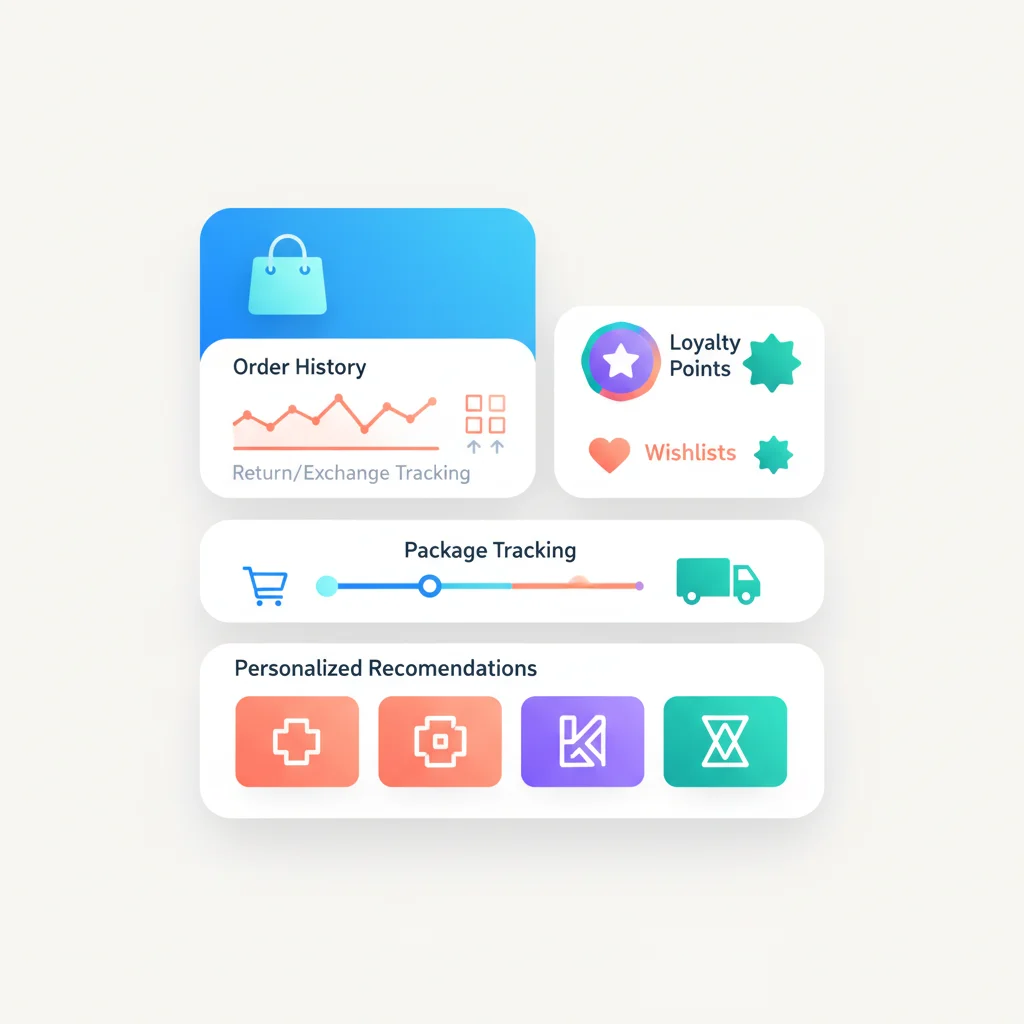
- Order tracking — Real-time status of orders with carrier tracking integration.
- Returns and exchanges — Self-service return initiation, label generation, and exchange management.
- Invoice and receipt access — Downloadable invoices, receipts, and tax documents.
- Subscription management — Manage recurring orders, adjust frequency, skip deliveries, or cancel.
- Loyalty and rewards — Points balance, reward history, and redemption options.
- B2B account management — Multiple users, approval workflows, purchase orders, and credit management.
- Wishlist and saved items — Persistent product collections and price-drop notifications.
- Reorder — One-click reorder from previous purchases for consumable or recurring products.
E-Commerce Portal Software
- Shopify — The most accessible option for small online retailers, with built-in customer accounts, order history, and tracking. Shopify Plus adds B2B capabilities with company accounts and custom pricing.
- Magento / Adobe Commerce — Comprehensive B2B and B2C portals with company accounts, requisition lists, and negotiated pricing. Designed for mid-size to enterprise operations with complex catalog needs.
- BigCommerce — E-commerce platform with B2B edition featuring customer portals, price lists, and quote management. Popular among growing merchants that need more flexibility than Shopify offers.
- WooCommerce — WordPress-based e-commerce with various portal plugins (MyAccount extensions, B2B plugins). A natural fit for small businesses already running WordPress.
- OroCommerce — Purpose-built for B2B e-commerce with advanced customer portal features including multi-user accounts and approval workflows. Typically chosen by established distributors and manufacturers moving online.
For loyalty and subscription-specific portals, platforms like Yotpo (loyalty) and Recharge (subscriptions) provide dedicated customer-facing experiences.
What an E-Commerce Portal Looks Like in Practice
The “My Account” page on most online stores barely qualifies as a portal — it is a list of past orders and a password reset link. Here is what it looks like when e-commerce businesses take the customer portal seriously.
Start with the B2C side. A customer who bought running shoes from a small online retailer logs in a week later because the fit is not quite right. In the portal, they initiate a return, select “wrong size” as the reason, get a prepaid shipping label generated instantly, and choose to exchange for a half-size up. The replacement ships before the return even arrives. No email to customer service, no waiting for a reply, no frustration. That frictionless return experience is what turns a potential one-star review into a repeat customer. Shopify makes this kind of self-service account area accessible even for small retailers, and it is where most direct-to-consumer brands start.
The B2B side is where portals become truly indispensable. Picture a buyer at a regional plumbing supply distributor logging into their portal. They see their negotiated pricing — different from the public catalog because their company has a volume agreement. They add pipe fittings and valves to a requisition list, submit it for internal approval by their purchasing manager, and once approved, the order is placed automatically. They track the shipment in real time, download the invoice for their accounting system, and reorder last month’s supplies with one click. This kind of workflow — custom pricing, multi-user accounts, approval chains, and rapid reordering — is table stakes for B2B but impossible to deliver without a proper portal.
OroCommerce is purpose-built for exactly this kind of B2B complexity. It handles multiple price lists per customer, corporate account hierarchies where a purchasing manager and a warehouse clerk have different permissions, and quote-to-order workflows that mirror how B2B buying actually works. It is not the tool for a small DTC brand selling candles — it is for the distributor or manufacturer with hundreds of SKUs and buyers who place the same orders every month.
The gap between basic and great is enormous in e-commerce. A basic “My Account” page answers “where is my order?” A real portal answers that plus “can I return this?”, “what did I order last quarter?”, “what is my company’s negotiated price?”, and “can I set this up as a recurring order?” The businesses that close that gap are the ones that turn transactions into relationships.