Your members text to book classes, email about billing, DM you on Instagram for the Saturday schedule, and call when they can’t find their membership card. You’re running a fitness business, but half your day feels like customer service triage across five different channels.
A member portal for fitness and wellness businesses consolidates bookings, payments, progress tracking, and communication into one branded experience. Members get 24/7 self-service access. You get fewer interruptions and a more professional operation.
Problems a Portal Solves for Fitness & Wellness Businesses
Class booking is a logistical nightmare
Studios and gyms that run group classes — yoga, CrossFit, spin, pilates, HIIT — deal with a constant stream of booking, cancellation, and waitlist management. When booking happens through text messages, phone calls, or a patchwork of apps, double-bookings happen, no-shows pile up, and popular classes fill up without any waitlist mechanism.
A portal with online class scheduling lets members browse the weekly schedule, book their spot, join waitlists, and cancel — all without contacting staff. Automated reminders reduce no-shows. Capacity limits are enforced automatically. And when someone cancels a spot in a full class, the next person on the waitlist gets notified instantly.
For studios that charge per class or use class packs, the portal deducts credits automatically at booking. No more tracking who has how many classes left on a spreadsheet.
Membership management is manual and error-prone
Membership plans, freezes, upgrades, downgrades, cancellations, family add-ons — managing all of this through a combination of spreadsheets, email, and your POS system is a recipe for billing errors and awkward conversations.
A portal with billing and payment capabilities lets members manage their own membership. They can view their plan details, update payment methods, freeze their membership (within your rules), and see their billing history. When a credit card expires, the portal prompts them to update it before the next charge fails — instead of you chasing them down after the fact.
Progress tracking lives in members’ heads (or nowhere)
Members who can see their progress stick around longer. But most fitness businesses don’t give members any structured way to track workouts, measurements, goals, or milestones. Personal trainers scribble notes on clipboards. Group fitness instructors have no idea if a member has attended 5 classes or 50.
A portal with progress tracking — workout logs, body measurements, attendance streaks, personal records — gives members a reason to log in beyond just booking classes. It turns the portal from a transactional tool into an engagement tool. And for personal trainers, having a shared view of client progress means sessions are more productive because you’re not spending the first five minutes asking “what did we do last time?”
Communication is scattered everywhere
Members reach out however is most convenient for them — text, email, Instagram DMs, WhatsApp, phone calls, and stopping staff mid-workout on the gym floor. Important information gets lost. Questions go unanswered for days. And staff can’t keep track of who said what where.
Secure messaging inside a portal centralizes member communication. Questions about schedules, injury modifications, billing issues, and training programs all live in one place. Staff can respond when they have time rather than being pulled in five directions simultaneously.
Waivers and forms are still on paper
New member onboarding at most fitness businesses starts with a clipboard. Health questionnaires, liability waivers, emergency contact forms, PAR-Q assessments — all on paper, all filed in a cabinet, all impossible to find when you need them.
Digital intake through a portal lets new members complete everything before their first visit. The information is stored digitally, easily searchable, and automatically associated with their member profile. When a member mentions a knee injury during a personal training session, the trainer can pull up their health questionnaire on the spot.
Key Features for Fitness & Wellness Portals
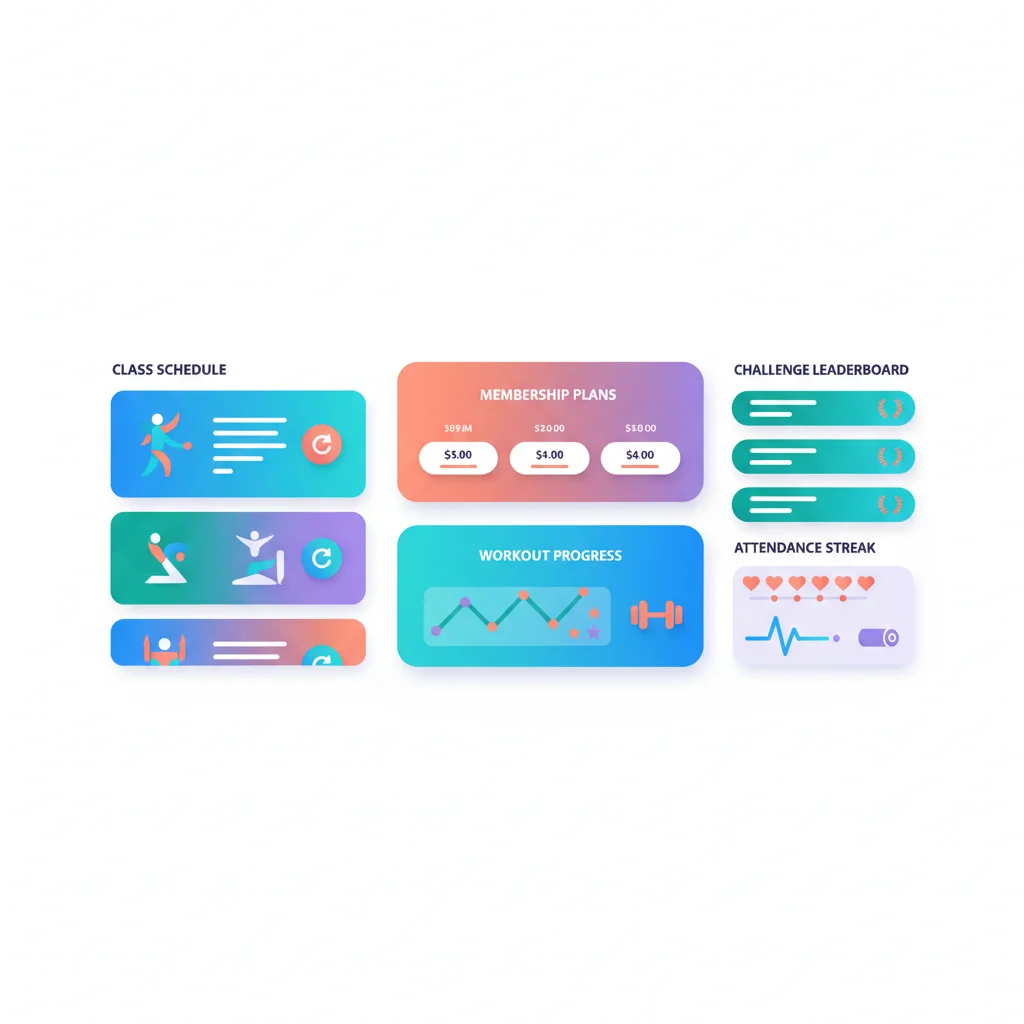
- Class scheduling and booking — Browse schedules, book classes, join waitlists, and cancel with automated capacity management and reminders.
- Membership management — View plan details, upgrade/downgrade, freeze membership, update payment methods, and manage family members.
- Billing and payments — Recurring membership charges, class pack purchases, personal training packages, and retail purchases with full payment history.
- Workout and progress tracking — Log workouts, track body measurements, record personal records, and view attendance history.
- Personal training management — Book sessions with specific trainers, access workout plans, view session notes, and track remaining sessions in a package.
- Digital waivers and forms — Health questionnaires, liability waivers, PAR-Q assessments, and emergency contacts completed online.
- Secure messaging — Communicate with trainers and staff about scheduling, programming, injuries, and account questions.
- Challenge and goal tracking — Join fitness challenges, track progress against goals, and see leaderboards.
- Resource library — Access workout videos, nutrition guides, exercise tutorials, and wellness resources.
- Notifications and reminders — Class reminders, membership renewal alerts, challenge updates, and promotional announcements.
Fitness & Wellness Portal Software
- Mindbody — The dominant platform for fitness studios, gyms, and wellness businesses with scheduling, payments, a branded member app, marketing tools, and retail management. Used by tens of thousands of studios worldwide.
- Glofox — Gym and studio management platform with a branded member app, class booking, membership management, and payment processing. Strong among boutique fitness studios.
- Wodify — Built specifically for CrossFit boxes and functional fitness gyms with WOD tracking, performance benchmarking, and class management.
- PushPress — Gym management platform with a member app, booking, billing, and check-in. Popular among independent gym owners who want simplicity.
- Zen Planner — Management software for fitness businesses with scheduling, billing, attendance tracking, and a member portal. Strong in martial arts and CrossFit.
- Vagaro — Booking and business management for fitness, beauty, and wellness with a consumer marketplace, memberships, and payroll.
- TeamUp — Class and membership management for boutique fitness with booking, payments, and customer management.
- Exercise.com — Platform for personal trainers and gym owners with workout delivery, booking, e-commerce, and a custom-branded app.
For larger gym chains and multi-location operations, enterprise platforms like ABC Fitness (formerly ABC Financial) provide comprehensive club management with member-facing portals, billing, and access control.
Member Retention: The Real Reason Portals Matter
Here’s the uncomfortable truth about the fitness industry: the average gym loses 30-50% of its members every year. That’s not a scheduling problem or a facility problem — it’s a relationship problem. Members who feel connected to the community and can see their own progress stay. Members who feel like an anonymous credit card number leave.
A portal directly addresses the factors that drive retention:
Engagement visibility. When a member hasn’t checked in for two weeks, the portal (and your staff) know. Automated re-engagement messages — “We miss you! Here’s what’s coming up this week” — catch at-risk members before they mentally quit.
Progress documentation. Members who can see a chart showing they’ve attended 47 classes this year, lifted 15% more weight than three months ago, or completed a 30-day challenge feel invested. Abstract fitness goals become concrete, visible accomplishments.
Community connection. Challenge leaderboards, class attendance streaks, and member milestones create social accountability. When your Tuesday 6 AM crew can see each other on the booking list, they’re less likely to skip.
Friction reduction. Every unnecessary interaction — calling to book, emailing about billing, waiting to check in — is a tiny reason to not come to the gym. A portal removes all of them.
For more on how portals drive retention, see our article on customer retention strategies and how portals reduce churn.
What a Fitness Portal Looks Like in Practice
It’s 6:45 AM on a Wednesday. Sarah opens the gym’s app on her phone while making coffee. She can see she’s booked into the 7:30 AM HIIT class — confirmed, spot #8 of 20. Below that, a notification: the Thursday evening yoga class she waitlisted for just opened up, and she’s been auto-booked. She taps to confirm and glances at her progress dashboard. Forty-two classes attended this quarter. Her deadlift PR updated to 185 lbs after Monday’s session (her trainer logged it). She’s three classes away from completing the “50 Classes in 90 Days” challenge, and she can see she’s in fourth place on the leaderboard. She grabs her bag and heads to the gym with a little extra motivation.
At the gym, she checks in by scanning a QR code on her phone — no card, no front desk interaction. After class, she opens the app again and sees a message from her trainer: “Great work this week. I’ve updated your program for next week — added front squats since your back squat form is solid now. Check the workout plan tab.” She pulls up the plan, sees the exercises with video demos for the new movements, and mentally prepares for Monday.
This is the experience platforms like Mindbody enable at scale. Members get a branded app with class booking, waitlists, payments, and retail purchases — all under the studio’s brand. For studio owners, Mindbody also handles marketing, retail, and staff management, making it the operating system for tens of thousands of fitness businesses worldwide. The trade-off is complexity and cost — smaller studios sometimes find the platform overwhelming and expensive compared to lighter alternatives.
For CrossFit boxes and functional fitness gyms, Wodify delivers a more specialized experience. Members log their WOD results after each session, track PRs across dozens of benchmark workouts, and compare performance against gym averages. The leaderboard isn’t a gimmick — it’s central to CrossFit culture, and having it baked into the portal drives the competitive engagement that keeps members showing up at 5 AM. Coaches can program workouts in advance, and members see what’s coming before they walk in, which builds anticipation and ensures they bring the right gear.
For independent gym owners who want something simpler, PushPress strips away the complexity and focuses on the essentials: a clean member app, class booking, billing, and check-in. It’s the kind of platform where you can be up and running in a day without watching hours of tutorial videos. The member experience is straightforward — book, pay, show up, track attendance — and for many small gyms, that’s exactly the right level of functionality.