
When a family walks through your door, they’re dealing with one of the worst days of their life. The last thing they need is more friction — chasing down documents, making decisions under pressure during a single in-person meeting, or calling your office repeatedly to confirm details they can’t remember because they were in shock when you first discussed them.
A family portal for funeral homes provides a private, secure space where families can review service arrangements, share memorial information, upload photos, manage payments, and coordinate with extended family — all at their own pace, on their own time.
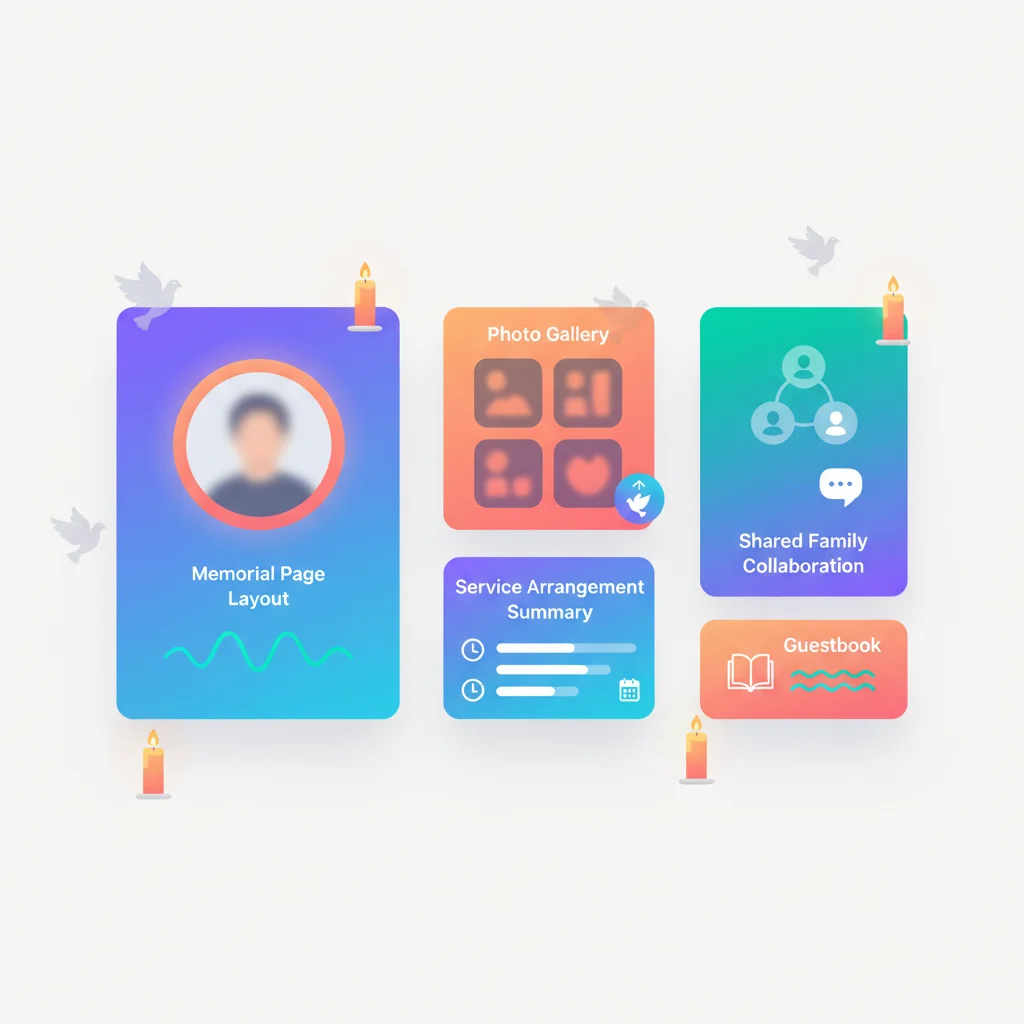
Problems a Portal Solves for Funeral Homes
Families can’t absorb everything in one meeting
The arrangement conference is overwhelming. Families are making dozens of decisions — casket or cremation, service location, flowers, music, readings, obituary wording, legal documents, payment — while processing grief. Research consistently shows that people under emotional stress retain far less information than usual.
A portal where families can review every decision, see itemized costs, and revisit arrangements after the meeting gives them space to process. They can share the details with family members who weren’t present, make changes after reflection, and feel confident that nothing was missed.
Coordinating with extended family is chaos
When a parent or grandparent dies, the coordination involves siblings, in-laws, distant relatives, and family friends — often spread across multiple states or countries. Currently, this coordination happens through group texts, email chains, and phone trees that inevitably leave someone out of the loop. A secure messaging feature keeps all communication in one private channel.
A portal with a shared memorial page gives everyone one place to go for service details — date, time, location, livestream link, parking instructions, reception information. Family members can upload photos for a slideshow, submit stories or memories for the eulogy, and RSVP for the reception. Instead of the primary contact fielding 30 phone calls with the same questions, the portal handles it.
Pre-planning records are hard to find
Many funeral homes offer pre-planning services where individuals arrange and sometimes pre-pay for their own funeral. These plans may not be activated for years or even decades. When the time comes, the family needs to locate the pre-plan, verify what was arranged, and understand what’s already paid for.
A portal where pre-plan holders can access their arrangements, update preferences, and store important documents (will, advance directives, insurance policies) ensures nothing is lost. When the plan is activated, the family has immediate access to everything.
Payment conversations are awkward and stressful
Discussing costs during a grief-stricken arrangement meeting is uncomfortable for everyone. Families feel pressured, and directors feel awkward presenting pricing when a family is in tears.
A portal with transparent billing and payment capabilities lets families review itemized costs privately, compare package options at their own pace, set up payment plans, and pay online. The financial conversation becomes less pressured and more transparent — which actually leads to better outcomes for both parties.
Obituary and memorial content takes multiple rounds
Writing an obituary, selecting photos for a slideshow, choosing music, and deciding on readings involves multiple family members and multiple revisions. When this happens over email, versions get confused, feedback gets lost, and the funeral home staff ends up managing a content production process on top of everything else.
A portal where family members can collaboratively draft the obituary, upload and select photos, and indicate preferences for music and readings streamlines this process. The funeral home staff sees the latest version without chasing updates.
Key Features for Funeral Home Portals
- Arrangement summary — Complete overview of service plans, selected options, and timeline, reviewable anytime after the arrangement conference.
- Memorial page — Shareable page with service details, obituary, photo gallery, livestream link, and guestbook for condolences.
- Photo and media upload — Family members upload photos and videos for slideshows and memorial displays.
- Obituary collaboration — Draft, edit, and approve obituary text with input from multiple family members.
- Document management — Secure storage and sharing of death certificates, insurance documents, pre-plan paperwork, and legal forms.
- Billing and payments — Itemized cost breakdown, payment plan setup, online payments, and insurance assignment tracking.
- Pre-planning portal — View and update pre-arranged plans, store personal documents, and record preferences.
- Service coordination — RSVP management, livestream access, parking and venue information, and reception details.
- Flower and donation management — Track floral arrangements, charitable donations in lieu of flowers, and acknowledgment cards.
- Aftercare resources — Grief support resources, estate administration checklists, and follow-up appointment scheduling.
Funeral Home Portal Software
- Passare — Cloud-based funeral home management with a family collaboration portal, arrangement tools, and case management. The planning center lets families participate in arrangements remotely.
- Gather — Memorial technology platform with customizable memorial pages, RSVP management, livestreaming, and a family collaboration portal.
- Tukios — Funeral home website and technology provider with tribute video creation, obituary publishing, and livestreaming.
- FuneralOne — Funeral home website and technology platform with memorial pages, tribute videos, and planning tools.
- Frontrunner Professional — Funeral home website provider with memorial pages, livestreaming, grief resources, and family collaboration features.
- CRAKN — Cloud-based funeral home management system with case management, accounting, and family-facing features.
For funeral homes that want more customization or need to integrate with existing management systems, general-purpose portal platforms like Clinked or SuiteDash can be configured to provide a family collaboration space.
The Sensitivity Factor
Funeral home technology has to meet a higher bar than most industries. The design, tone, and user experience must be respectful and understated. A portal that feels like a tech startup — bright colors, gamification, push notification overload — would be deeply inappropriate.
The best funeral home portals feel like a quiet, well-organized room. Clean design. Muted colors. Clear navigation. No friction. Families should be able to find what they need without hunting, upload photos without technical difficulty, and pay without confusion. The technology should be invisible — it’s there to reduce stress, not create a “digital experience.”
This also applies to notifications. Automated messages to grieving families must be carefully worded and timed. A payment reminder sent two days after a funeral needs a very different tone than a SaaS subscription renewal notice.
For guidance on designing thoughtful user experiences, see our UX design guide.
Reaching Families Who Aren’t in the Room
One of the most practical benefits of a portal is reaching family members who can’t be present for the arrangement conference. Adult children who live in other states. Elderly relatives who can’t travel. Family members overseas. In today’s distributed families, it’s common for key decision-makers to be hundreds or thousands of miles away.
A portal where remote family members can review arrangements, view itemized pricing, provide input on obituary text, upload photos, and even participate in decisions gives them meaningful involvement without requiring travel. This is particularly valuable when multiple siblings need to agree on arrangements and costs — having everything documented in the portal reduces family conflict and miscommunication.
Livestreaming of services, accessible through the portal, has become a permanent expectation since 2020. Families now assume that remote attendance is an option, and portals that integrate livestreaming provide a complete remote experience — not just watching the service, but participating in the broader memorial.
What a Funeral Home Portal Looks Like in Practice
The Anderson family lost their father on a Monday. By Tuesday afternoon, they’ve completed the arrangement conference at the funeral home — choosing a traditional service with burial, selecting a casket, and discussing the obituary. It was exhausting and emotional, and by the end, the details were blurring together.
That evening, the eldest daughter — the primary contact — receives an email with a link to the family portal. She logs in and sees everything laid out clearly: the full arrangement summary with every selection they made, an itemized cost breakdown showing the casket, vault, service fees, and cemetery charges, and a timeline for the next five days. She forwards the portal link to her two brothers (one in Denver, one in London) and her mother.
Over the next 48 hours, the family collaborates through the portal. Her brother in Denver uploads childhood photos of their father for the slideshow. Her mother drafts the obituary, and all three siblings edit and approve it. The brother in London selects a reading for the service and RSVPs for the livestream since he can’t get a flight in time. The funeral home staff sees all of this activity without a single phone call — the photos are organized, the obituary is finalized, and the service details are confirmed.
Passare is the platform most funeral homes associate with this kind of family collaboration experience. Their Planning Center lets families participate in arrangements from anywhere — reviewing options, approving selections, and providing information the funeral home needs (like Social Security numbers for death certificate filing) through a secure portal rather than over the phone. For funeral homes that serve families spread across the country, this remote collaboration capability fundamentally changes how arrangements work.
Gather takes a different approach, focusing specifically on the memorial experience. The memorial pages are beautifully designed and shareable — families send a single link to everyone, and guests can leave condolences, view the photo gallery, watch the livestream, and even donate to a designated charity. For funeral homes that want to differentiate on the digital memorial experience, Gather provides a polished product that families genuinely appreciate during an awful time.
The payment side quietly resolves itself through the portal too. The Anderson family reviews the itemized costs, compares what their father’s pre-plan covers versus the remaining balance, and the three siblings split the difference through online payments — no awkward phone calls about money, no checks mailed back and forth. The funeral home receives payment faster, and the family handles the financial logistics privately.