
Nobody calls their insurance company for fun. But policyholders still pick up the phone for ID cards, coverage questions, and claims updates — because there’s nowhere else to go. Every one of those calls costs you money and costs them patience.
A customer portal for insurance gives policyholders a self-service hub where they can file claims, pull up ID cards, check coverage, and pay bills — all without waiting on hold. For your team, it means fewer routine calls and lower operational costs.
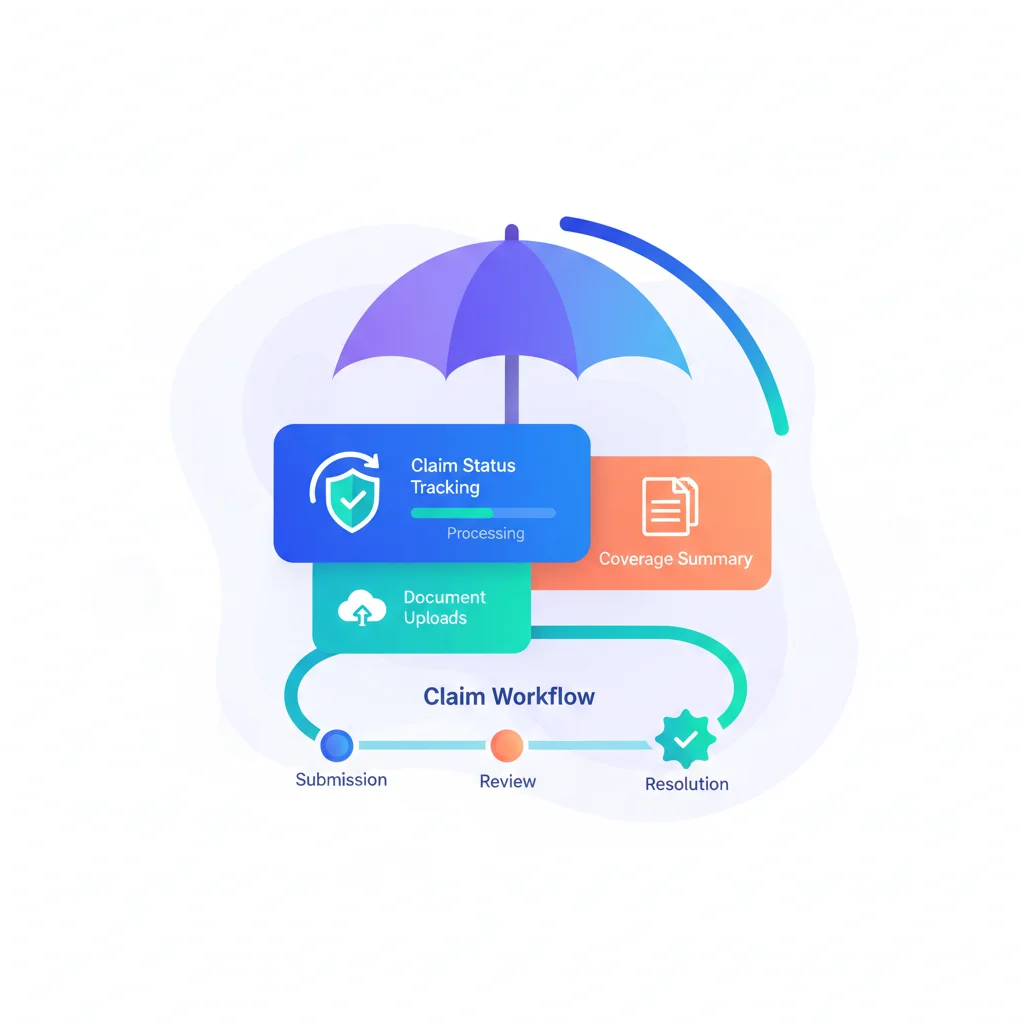
Problems a Customer Portal Solves for Insurance
Call center overload with routine inquiries
A significant portion of insurance call center volume consists of routine questions: “What’s my policy number?” “When is my next payment due?” “What does my policy cover?” Each of these calls costs money and creates wait times. A self-service portal moves these inquiries to a digital channel where customers find answers instantly.
Slow claims processes
Filing a claim traditionally involves phone calls, paper forms, and waiting. A portal lets policyholders file claims online, upload supporting documentation (photos, receipts, police reports), and track the status of their claim in real time.
Policy document management
Insurance generates mountains of paperwork — declarations pages, endorsements, certificates of insurance, claim letters. A portal provides a centralized, searchable document repository where policyholders access current and historical documents anytime.
Agent and broker access challenges
For insurance companies working through independent agents and brokers, providing portal access to these intermediaries (not just end policyholders) creates a more efficient distribution channel.
Key Features for Insurance Portals
- Policy management — View coverage details, deductibles, limits, endorsements, and policy documents.
- Claims filing and tracking — Submit new claims with supporting documents and track progress through adjudication.
- Digital ID cards — Instantly access proof of insurance from any device.
- Billing and payments — View bills, set up autopay, make one-time payments, and review payment history.
- Certificate requests — Commercial policyholders can request certificates of insurance on demand.
- Document library — Access all policy documents, correspondence, and claim records.
- Quote and renewal management — Review upcoming renewals, see quotes for additional coverage, and make changes to existing policies.
- Agent/broker portal — A separate (or segmented) view for intermediaries to manage their book of business.
How Portals Drive Policyholder Retention
Insurance is a competitive market where switching costs are low. Customers who never interact with their insurance company (beyond paying premiums) have weak loyalty. A portal changes this dynamic by creating regular engagement touchpoints.
When policyholders log in to check their coverage, download documents, or review their billing, they’re interacting with your brand. That interaction builds familiarity and reduces the likelihood of switching at renewal time. Companies that offer strong digital self-service reduce churn and improve Net Promoter Scores.
The J.D. Power Insurance Digital Experience Study consistently shows that digital capabilities are a major driver of customer satisfaction in insurance.
Insurance Portal Software Examples
- Majesco — Digital platform for insurance with policyholder portals, agent portals, and claims management.
- Guidewire — Core insurance platform with digital engagement capabilities including self-service portals.
- Duck Creek — SaaS platform for P&C insurance with customer-facing portal modules.
- Applied Epic — Agency management system with a client-facing portal (Applied CSR24).
- EZLynx — Agency management platform with a client portal for independent agents.
For smaller agencies, general-purpose portals like Assembly or SuiteDash can work well for basic document sharing and communication, though they won’t have insurance-specific features.
What a Policyholder Portal Looks Like in Practice
Here’s a scenario every insurance agent knows: a small business owner lands a new client, and that client needs a certificate of insurance before the contract can move forward. It’s 4:30pm. The business owner calls their insurance agency, gets voicemail, leaves a message, and then sits there hoping someone calls back before 5pm. Meanwhile, the deal is on hold.
Now imagine the same situation with a portal. The business owner logs in, clicks “Certificates,” fills in the certificate holder information (the new client’s name and address), and downloads a PDF certificate of insurance in under two minutes. Deal moves forward. No phone call, no waiting, no anxiety. That single workflow — on-demand certificate generation — is the feature that makes portal-skeptic business owners suddenly understand what all the fuss is about.
Applied Epic with its CSR24 client portal is the setup most commonly seen in independent insurance agencies. Applied Epic is the dominant agency management system in the independent agent channel, and CSR24 is its customer-facing portal layer. Policyholders can log in to access their digital ID cards (no more fumbling through the glove box), view policy details and coverage summaries, request policy changes, and submit first notice of loss for claims. For the agency, it means fewer routine calls and a more professional client experience. Many independent agents rely on CSR24 as their primary self-service tool — it’s not flashy, but it gets the job done for the workflows that matter most.
For smaller agencies that don’t need a full insurance-specific portal — maybe a two-person shop that writes mostly personal lines — platforms like Assembly or SuiteDash can handle the basics. They won’t generate certificates of insurance or pull policy data from a carrier system, but they provide a branded, secure place to share documents, communicate with clients, and handle routine requests. Sometimes that’s all a small agency needs to stop drowning in email and start looking like a modern operation.