If your buyers still place orders by phone or email, you’re leaving money and efficiency on the table. In a world where everyone expects Amazon-level self-service, making customers call for pricing or fax a PO feels like a relic.
A customer portal for manufacturers creates a digital self-service channel where B2B customers place orders, check inventory and pricing, track shipments, and access technical documentation — around the clock, without tying up your sales or support teams.
Problems a Customer Portal Solves for Manufacturers
Order management by phone and email
Many manufacturers still process orders through phone calls, emailed POs, and fax. This is slow, error-prone, and impossible to scale. A portal with online ordering lets customers place orders directly against current pricing and inventory, reducing order entry errors and processing time.
Product documentation scattered across systems
Data sheets, CAD files, installation guides, safety information, compliance certificates — manufacturers produce extensive documentation for their products. When this is scattered across email, FTP servers, and sales reps’ laptops, customers can’t find what they need. A portal with organized document management solves this.
Pricing complexity
B2B pricing in manufacturing is often customer-specific, with negotiated contracts, volume discounts, and tiered pricing. A portal that shows each customer their specific pricing (pulled from your ERP) eliminates pricing confusion and reduces quote-related back-and-forth.
Shipment tracking inquiries
“Where’s my order?” is one of the most common inquiries manufacturers receive. A portal that integrates with your logistics systems and shows real-time shipment tracking reduces these calls.
Key Features for Manufacturing Portals
- Online ordering — Customers browse your catalog, see their contract pricing, and place orders directly. Integration with ERP (SAP, Oracle, Microsoft Dynamics) for real-time pricing and inventory.
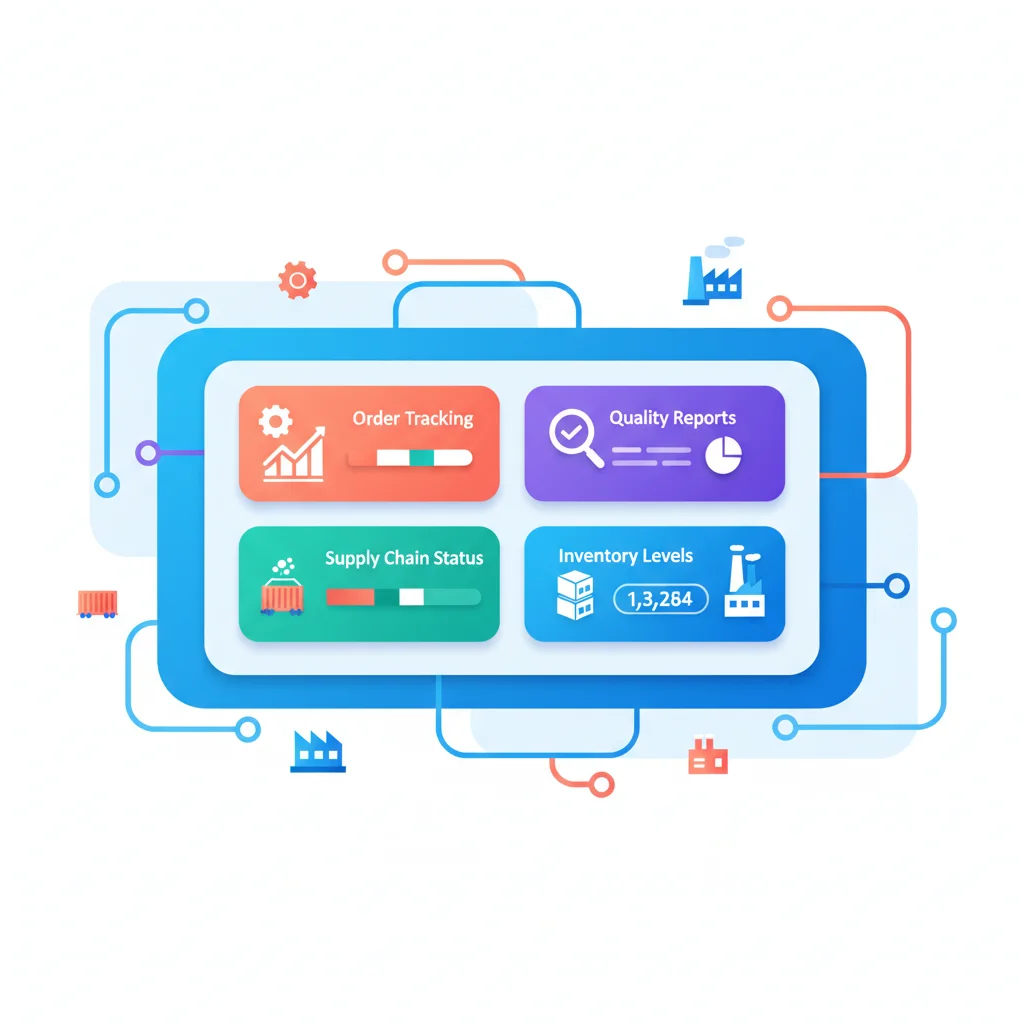
- Order tracking — Real-time status of open orders, shipment tracking, and delivery confirmation.
- Product catalog — Searchable catalog with specifications, images, data sheets, and related products.
- Technical documentation — CAD files, installation guides, material safety data sheets (MSDS), compliance certificates.
- Pricing and quotes — Customer-specific pricing, quote requests, and quote-to-order conversion.
- Warranty and service — Register products, file warranty claims, request service, and track repair status.
- Reorder functionality — Quick reorder from purchase history and saved order templates.
- Account management — Multiple users per account with different roles (purchasing, engineering, finance).
Manufacturing Portal Software
- SAP Commerce Cloud — Enterprise B2B commerce platform with self-service portal capabilities, integrated with SAP ERP.
- Oracle CX Commerce — B2B commerce platform with customer portal features for Oracle shops.
- Magento (Adobe Commerce) — B2B e-commerce platform with customer portals, requisition lists, and company accounts.
- Sana Commerce — B2B e-commerce integrated directly with SAP and Microsoft Dynamics ERP.
- OroCommerce — B2B e-commerce platform purpose-built for manufacturers and distributors.
- Liferay — Digital experience platform with B2B portal and commerce capabilities.
For smaller manufacturers that don’t need full e-commerce, a general-purpose portal like Assembly or Clinked can handle document sharing, communication, and basic order tracking.
What a Manufacturing Portal Looks Like in Practice
Let’s make this concrete. Imagine you’re a purchasing manager at an HVAC contractor, and you need to order parts from one of your regular suppliers. Instead of calling your sales rep, waiting for a callback, and then emailing a PO, you log into the supplier’s portal. Right there on your dashboard, you see your negotiated contract pricing — the rates your company locked in, not the list prices. You search for condenser units, confirm that 50 are available at the nearest warehouse, add them to a requisition, and submit the purchase order. Within hours, the system confirms a 3-day lead time and provides a tracking number. Done in minutes, not days.
But it’s not just ordering. You can pull up all your open orders and see exactly where each one stands — shipped, in production, awaiting fulfillment. Your accounting team needs invoices? They download them directly from the portal instead of emailing your sales rep and waiting. And when it’s time to reorder the same supplies you bought last month, one click brings up your previous order as a template. No re-entering part numbers, no digging through old emails for quantities.
Sana Commerce is a strong example of this kind of portal in action. It’s built specifically for manufacturers running SAP or Microsoft Dynamics ERP, and it creates a B2B storefront that pulls real-time pricing and inventory directly from your ERP system. Customers always see accurate data because there’s no sync delay or separate product database to maintain. It’s particularly popular among mid-size manufacturers who want to give their buyers a modern online ordering experience without having to rebuild their entire pricing logic from scratch.
For smaller manufacturers, you don’t have to start with full e-commerce. Many begin with a basic portal focused on sharing technical documentation — spec sheets, CAD files, MSDS documents — and handling quote requests digitally. That alone eliminates a surprising amount of back-and-forth. Once your customers get comfortable finding what they need on their own, you can layer on online ordering, inventory visibility, and reorder tools as the business grows. The key is to start where the friction is highest and build from there.