Your donors want receipts. Your members want benefits. Your volunteers want schedules. Your board wants reports. And your team is drowning in spreadsheets trying to keep everyone happy.
A portal for nonprofits and associations gives each audience exactly what they need — donor dashboards, membership self-service, volunteer scheduling, board documents — without your staff playing middleman for every request.
Problems a Portal Solves for Nonprofits
Donor communication is reactive, not proactive
Most nonprofits communicate with donors when they need something: during fundraising campaigns, year-end appeals, and event invitations. Between those touchpoints, donors hear silence. They have no easy way to see their giving history, download tax receipts, or understand the impact of their contributions.
A donor portal changes that dynamic. Donors log in and see their complete giving history, tax-deductible receipts, impact reports, and updates on programs they’ve funded. It transforms the relationship from transactional to ongoing — and donors who feel connected give more.
Membership management is a spreadsheet nightmare
Associations live and die by their membership. But managing memberships — renewals, tier upgrades, benefit access, directory listings, event registrations — through manual processes is a constant administrative drain. Staff spend hours tracking who’s current, chasing renewals, and manually provisioning access to member-only resources.
A portal with self-service capabilities lets members manage their own profiles, renew memberships, access benefits, and update their information. Automated notifications handle renewal reminders. Membership status directly controls access to gated content and resources.
Volunteer coordination lives in email chains
Coordinating volunteers across events, shifts, and locations using email is like herding cats. Sign-up sheets get lost. Schedule changes don’t reach everyone. New volunteers don’t know where to go or what to do.
A portal gives volunteers a centralized place to view available opportunities, sign up for shifts, track their hours, access training materials, and communicate with coordinators. It’s especially valuable for organizations with recurring volunteer programs where the same people contribute regularly.
Grant reporting is manual and painful
Grant-funded nonprofits spend significant time on reporting — collecting data, compiling narratives, tracking outcomes, and assembling financial reports. When this data lives in multiple disconnected systems, report preparation becomes a multi-week exercise.
A portal with reporting dashboards can aggregate program data, financial information, and outcome metrics in one place. While it won’t write the grant report for you, it dramatically reduces the time spent gathering data.
Board members can’t find anything
Board governance requires document access — bylaws, meeting minutes, financial statements, strategic plans, committee reports. When these are distributed via email attachments, board members inevitably can’t find the document they need five minutes before a meeting.
A board portal (or a dedicated board section within a broader organizational portal) provides document management with organized access to all governance materials. Board members access current and historical documents anytime, without digging through email.
Key Features for Nonprofit and Association Portals
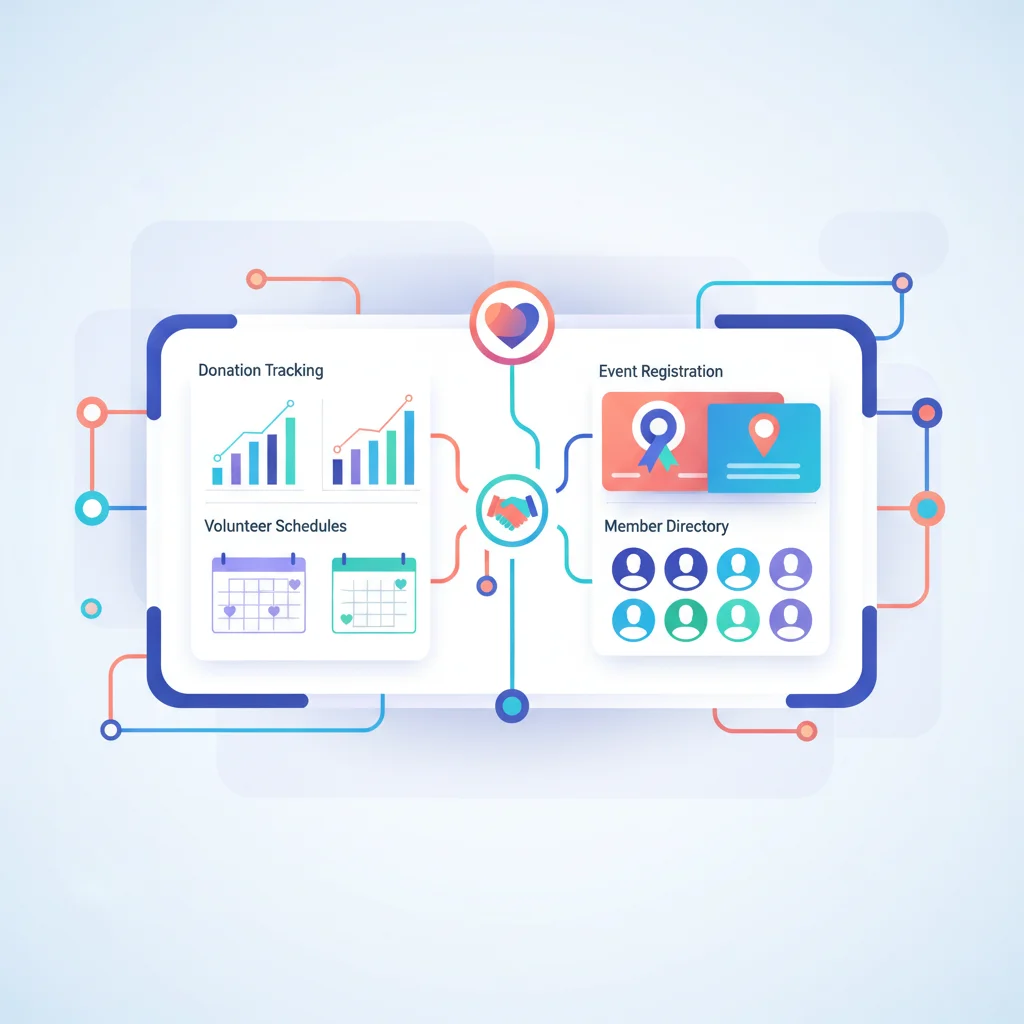
- Donor dashboard — Giving history, tax receipts, pledge tracking, and impact reports.
- Membership management — Online renewal, tier management, benefit access, and member directories.
- Volunteer management — Opportunity listings, shift scheduling, hour tracking, and training materials.
- Event registration — Online registration, payment processing, and attendee management.
- Resource library — Gated access to publications, research, templates, and educational content.
- Board portal — Governance documents, meeting minutes, agendas, and voting tools.
- Communication hub — Announcements, newsletters, and secure messaging between staff and constituents.
- Reporting dashboards — Program metrics, financial summaries, and outcome tracking for grants and board reporting.
- Payment and billing — Membership dues, event fees, and donation processing with receipt generation.
- Directory and networking — Member directory with profiles, searchable by location, specialty, or interest.
Association Membership Portals
Professional associations, trade groups, and industry organizations have a specific portal use case that deserves attention. Their members pay dues in exchange for benefits: continuing education, networking, industry research, certification programs, advocacy, and events.
An association membership portal needs to deliver tangible value that justifies annual dues. If a member can’t easily access their benefits, they won’t renew. The portal becomes the primary touchpoint for the value proposition.
Key association-specific features include:
- Continuing education tracking — Log credits, view transcripts, and access online courses.
- Certification management — Track certification status, renewal requirements, and professional development.
- Industry research and publications — Gated access to reports, white papers, and industry data.
- Job boards — Members post or browse job opportunities within the industry.
- Mentorship matching — Connect experienced members with newer professionals.
- Chapter and committee management — Local chapter portals with their own events, resources, and communication.
The key insight for associations is that portal adoption directly correlates with membership renewal. Members who log in regularly and use the portal’s resources renew at significantly higher rates than those who don’t. Our article on portal adoption strategies covers practical approaches to drive engagement.
Nonprofit Portal Software
- Wild Apricot — Membership management platform with a member portal, event management, and website builder. Popular with small to mid-sized associations and nonprofits.
- MemberClicks — Association management software with member portals, event registration, and community features.
- YourMembership — AMS (Association Management Software) with portals, career centers, and learning management.
- Bloomerang — Donor management platform with donor-facing dashboards and engagement tracking.
- Galaxy Digital — Volunteer management platform with volunteer portals, scheduling, and hour tracking.
- Boardable — Board management platform with document sharing, meeting management, and voting.
- Neon CRM — Nonprofit CRM with donor portals, event management, membership, and fundraising tools.
- Glue Up — All-in-one engagement platform for associations with memberships, events, email, and community.
For organizations that need a unified experience across donors, members, and volunteers, a custom portal built on a no-code platform or through API integrations with existing CRM and AMS systems can be more effective than cobbling together multiple specialized tools.
Budget Considerations
Nonprofits typically operate with tight technology budgets. The good news is that many portal platforms offer nonprofit pricing (often 20-50% discounts). Some enterprise platforms have free tiers for small organizations.
When evaluating cost, consider the staff time currently spent on manual processes. If your team spends 10 hours per week on membership management, volunteer coordination, and donor communication that a portal could automate, that’s 500+ hours per year. The ROI often justifies the investment even for small organizations. See our article on measuring the ROI of a customer portal for a framework.
What Nonprofit Portals Look Like in Practice
Let’s walk through what this actually feels like for the people you serve. A recurring monthly donor logs into your organization’s portal to update their credit card — the one on file expired last month. While they’re there, they see their giving dashboard: total contributions for the year so far, a complete history of every gift, and a one-click download for last year’s tax-deductible receipt (no more emailing your development team in February asking for it). But here’s where it gets interesting. They also see an impact report: “Your contributions helped fund 42 after-school tutoring sessions this quarter.” That connection between their money and real outcomes isn’t just nice to have — it’s what turns a donor into a long-term partner. They bump their monthly gift up before logging out.
Now picture a different user: a member of a professional association. They open the portal, renew their annual membership in a couple of clicks, and register for next month’s industry conference at the member discount rate. Then they download the latest industry research report — one of the member-only resources that justified the dues in the first place. Before they close the tab, they check their continuing education credits: 12 of 20 required for the year. Everything they need to get value from their membership is in one place, and none of it required an email to your staff.
Wild Apricot is one of the most popular platforms for making this kind of member experience happen, especially for small nonprofits and associations. Members can renew memberships, register for events, update their profiles, and access member-only resources — all self-service. It’s widely used by local chambers of commerce, professional associations, and community organizations that need solid membership management without a big technology budget or a dedicated IT team.
On the donor management side, Bloomerang takes a retention-first approach that’s particularly smart for small nonprofits. The donor-facing dashboard shows giving history and impact updates, keeping contributors connected to your mission between campaigns. Behind the scenes, your team gets engagement scoring that predicts which donors are at risk of lapsing — so you can reach out before they drift away, not after. For organizations where every donor relationship matters (and when doesn’t it?), that kind of proactive insight makes a real difference.