
Rent checks in the mail. Maintenance requests via voicemail. Owner reports cobbled together in Excel. Property management in 2025 shouldn’t feel like 1995 — but for a lot of companies, it still does.
A property management portal gives tenants self-service tools for online payments and maintenance requests, while providing owners with real-time financial visibility. Your team gets their time back, and both audiences stop calling the office for things they could handle themselves.
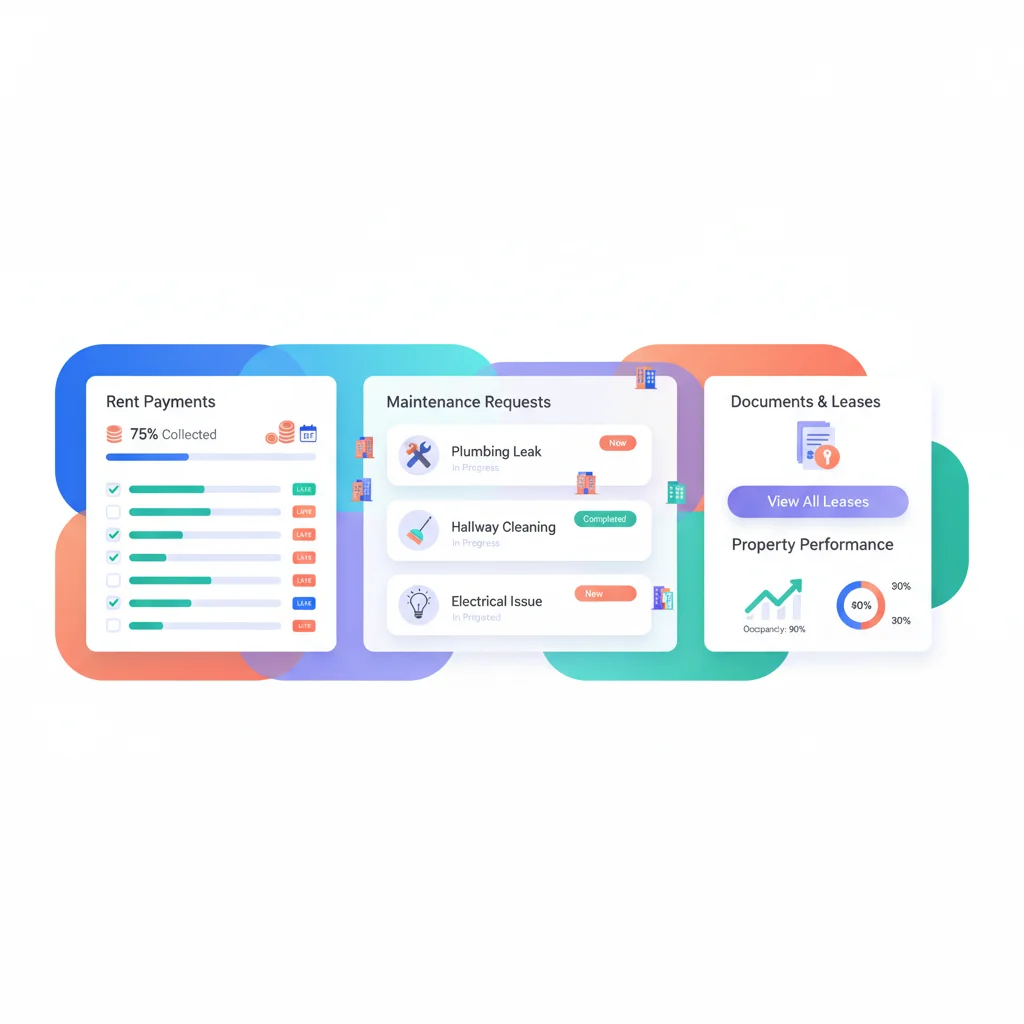
Problems a Portal Solves for Property Management
Rent collection is still stuck in the last century
Collecting rent by check is slow, unreliable, and labor-intensive. Checks get lost in the mail. They arrive late. They bounce. Processing each one takes manual effort — opening envelopes, recording payments, making bank deposits, updating ledgers. For a company managing 200 or 500 units, that’s a significant operational cost every single month.
A tenant portal with online rent payment eliminates most of that friction. Tenants pay via ACH or card. Payments are recorded automatically. Late payments trigger automated reminders. Recurring auto-pay reduces late payments even further. The result: faster collections, fewer delinquencies, and a lot less time spent processing paper.
Maintenance requests disappear into a black hole
The maintenance process at many property management companies goes like this: tenant calls the office, leaves a voicemail (because the line is busy), someone writes the request on a sticky note, it gets assigned to a tech at some point, and the tenant calls back three days later asking what happened.
A portal with ticketing and tracking turns maintenance into a structured process. Tenants submit requests online with descriptions and photos. Requests are categorized, prioritized, and assigned automatically. Tenants track the status of their request in real time. Work orders move through defined stages — submitted, assigned, in progress, completed — with notifications at each step.
This doesn’t just improve the tenant experience. It creates a maintenance history for each unit that’s invaluable for budgeting, insurance claims, and property sale due diligence.
Owners can’t see how their investment is performing
Property owners — whether they own a single rental house or a portfolio of 20 units — want financial transparency. How much rent was collected? What were the expenses? What’s the net operating income? What maintenance was performed?
Most property managers deliver this via monthly PDF reports sent by email. The reports are often late, sometimes inaccurate, and always static. Owners who want to drill into a specific expense or compare months have to call their property manager and wait for someone to pull up the numbers.
An owner portal with reporting dashboards provides real-time financial visibility. Owners see income statements, expense breakdowns, occupancy rates, and lease status — updated automatically from your property management system. They can access historical data, download reports, and review maintenance history without waiting for someone to compile it manually.
Lease document management is a filing cabinet nightmare
Every unit has a lease, and leases come with amendments, addendums, move-in checklists, inspection reports, and notices. Multiply that by hundreds of units and you have a document management challenge. When a tenant disputes a lease term or an owner asks for a copy of the current lease, someone has to dig through files — physical or digital — to find it.
A portal with document management organizes all property and lease documents in a structured, searchable system. Tenants access their own lease and related documents. Owners access property-level documents. Everything is versioned, dated, and accessible without a phone call.
Communication overload
Property management is communication-heavy. Move-in instructions, maintenance updates, lease renewal notices, community announcements, emergency notifications, owner distributions — the volume is constant. When communication happens through individual emails and phone calls, things get missed.
Secure messaging through a portal keeps communication organized and documented. Tenants receive announcements and can message management. Owners get property updates and can ask questions. Everything is logged, creating an audit trail that protects both parties.
Key Features for Property Management Portals
Tenant Portal
- Online rent payment — ACH, credit/debit card, and auto-pay with payment history and receipts.
- Maintenance requests — Submit requests with descriptions and photos, track status in real time.
- Lease access — View and download lease documents, amendments, and community rules.
- Communication — Receive announcements, submit questions, and message management.
- Move-in/move-out — Digital checklists, inspection reports, and security deposit tracking.
- Community features — Amenity reservations, package notifications, visitor parking, and community calendar.
Owner Portal
- Financial reporting — Income statements, expense breakdowns, cash flow summaries, and year-end tax documents (1099s).
- Property performance — Occupancy rates, rent roll, lease expirations, and market comparisons.
- Maintenance history — Complete maintenance log for each property and unit.
- Document access — Leases, insurance certificates, inspection reports, and property records.
- Distribution tracking — View owner distributions/draws and payment history.
- Approval workflows — Review and approve expenses above a defined threshold.
Property Management Portal Software
- AppFolio — Property management platform with tenant and owner portals, online payments, maintenance tracking, and accounting.
- Buildium — Property management software with tenant portals for payments and maintenance, plus owner portals for financial reporting.
- Rent Manager — Property management and accounting with tenant and owner portals and maintenance management.
- Propertyware — Single-family property management with tenant and owner portals, inspections, and maintenance.
- TenantCloud — Cloud-based property management with tenant portals, online payments, and maintenance tracking. Offers a free tier for small portfolios.
- DoorLoop — Modern property management software with portals, payments, accounting, and maintenance.
- Hemlane — Hybrid property management platform that combines software with optional human support.
For larger property management companies, enterprise platforms like Yardi Voyager and RealPage offer comprehensive portals as part of their property management suites.
The ROI of Going Digital
The return on investment for a property management portal is unusually straightforward to calculate:
- Online rent payment reduces processing costs by $5-15 per payment. At 300 units, that’s $1,500-$4,500 per month.
- Maintenance ticketing reduces phone calls by 40-60%, freeing staff time for higher-value work.
- Owner portals reduce monthly reporting time from hours per owner to minutes.
- Auto-pay enrollment typically reduces late payments by 20-30%, improving cash flow and reducing collection costs.
Most property management companies see positive ROI within 3-6 months of portal adoption. For a detailed framework, see our article on measuring the ROI of a customer portal.
What a Property Management Portal Looks Like in Practice
Let’s walk through a typical month from both sides — tenant and owner — to see what this looks like when it’s working.
It’s the 28th of the month. A tenant gets an automated reminder that rent is due in 3 days. They open the portal on their phone, see the balance, and their auto-pay is already set up — it’ll process on the 1st without them lifting a finger. While they’re in the app, they notice a notification: the maintenance request they submitted last week (a leaky kitchen faucet, with photos attached) has been updated to “Scheduled — plumber arriving Tuesday 9-11am.” They confirm the time works and go about their day. No phone calls made. No voicemails left. No wondering if anyone actually read the maintenance request.
Now flip to the owner’s side. A property owner with 6 rental units logs into the owner portal. The dashboard shows that 5 of 6 units collected rent on time this month. One unit is 3 days late, but an automated reminder was already sent — no manual follow-up needed. They download the monthly income statement: rent collected minus expenses (including that plumber for the kitchen faucet in unit 3). They check the year-to-date financials, see that their owner distribution was deposited yesterday, and close the tab. The entire check-in took less than five minutes, and they didn’t have to email their property manager for a single number.
AppFolio is one of the most popular platforms that delivers this dual-portal experience. It’s designed for property management companies handling anywhere from 50 to several thousand units, giving tenants online payments, maintenance tracking, and lease access while providing owners with real-time financial dashboards and automated monthly reports. The reason it’s so widely adopted is that it handles the full workflow — a tenant submits a maintenance request, the property manager assigns a vendor, the work gets completed and invoiced, and the expense automatically shows up on the owner’s financial statement. No manual data entry connecting the dots.
For smaller landlords and property managers — say, under 75 units — TenantCloud offers a more accessible entry point with tenant and owner portals, online payments, and maintenance tracking. It even has a free tier for very small portfolios, which makes it a practical starting point for independent landlords who are ready to stop collecting checks and fielding voicemails but aren’t ready to invest in a full enterprise platform.