
Your recruiters should be sourcing, screening, and closing placements. Instead, they’re playing human switchboard — fielding “where are we with that role?” calls from clients and “did I get the job?” emails from candidates all day long.
A client portal for staffing agencies gives each audience a self-service hub. Clients track open roles and candidate pipelines. Candidates manage applications and submit documents. Your recruiters get their time back for the work that actually generates revenue.
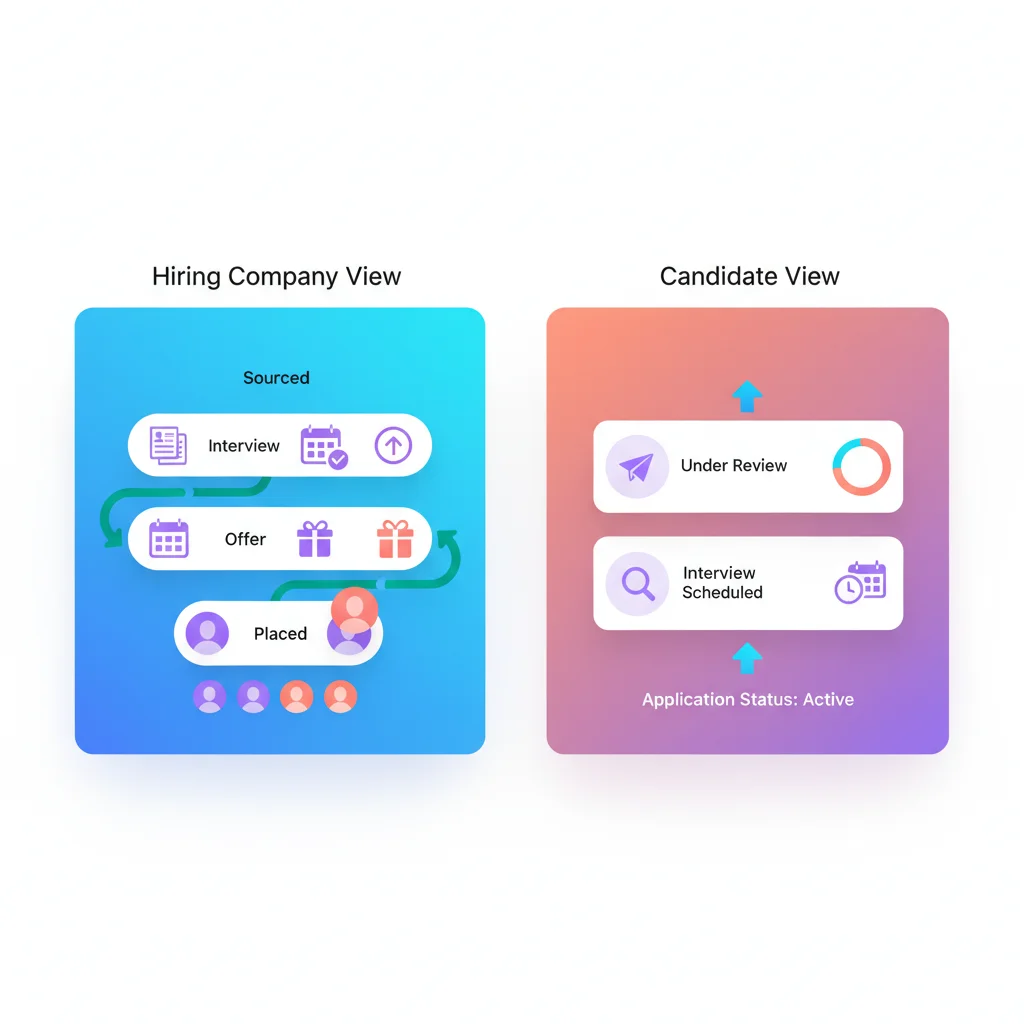
Problems a Portal Solves for Staffing Firms
Clients want visibility without the phone calls
When a company hires a staffing firm, they want to feel in control of the process even though they’ve outsourced it. They want to know: How many candidates have been sourced? Who’s been screened? Who’s in the interview pipeline? What’s the timeline?
Without a portal, every one of those questions turns into a phone call or email to their account manager. Multiply that across 30 or 50 active clients, and your team is spending more time reporting on work than doing work.
A client portal with reporting dashboards gives hiring managers real-time visibility into their requisitions. They see candidate counts by stage, interview schedules, time-to-fill metrics, and placement status — all without picking up the phone.
Candidates are in the dark about their status
The candidate experience at most staffing agencies is frustratingly opaque. Submit a resume, talk to a recruiter, and then… silence. Candidates don’t know if they’ve been submitted to a role, rejected, or forgotten. So they call. Or email. Repeatedly.
A candidate portal lets applicants track their application status, see which roles they’ve been submitted for, view upcoming interview schedules, and receive automated notifications when their status changes. It’s basic transparency, but it dramatically reduces inbound inquiries and improves the candidate experience.
Document collection is a bottleneck
Staffing firms collect mountains of documents: resumes, certifications, licenses, background check authorizations, tax forms (W-4, I-9), direct deposit forms, and compliance documentation. Collecting these via email — with attachments getting lost, wrong versions being submitted, and follow-up required for missing items — slows down the placement process.
A portal with document management provides a structured place for candidates to upload required documents. Checklists show what’s been submitted and what’s still needed. Automated reminders chase outstanding items. Everything is organized and accessible, not buried in an email thread.
Timesheet and billing disputes
For staffing firms that place temporary or contract workers, timesheets are a weekly reality. Paper timesheets and emailed spreadsheets create delays, errors, and disputes. Clients question hours. Workers dispute missing time. And the billing team is stuck in the middle trying to reconcile everything.
A portal with digital timesheet submission — where workers log hours and clients approve them — creates a clear, auditable process. Approved timesheets flow directly into billing, reducing errors and speeding up invoicing.
Compliance tracking across placements
Depending on the industry (healthcare staffing, IT staffing, industrial staffing), compliance requirements vary. Certifications expire. Background checks need renewal. Training requirements change. Tracking all of this manually across hundreds or thousands of active workers is a compliance risk.
A portal that tracks credential expiration dates, sends automated renewal reminders, and flags non-compliant workers before they’re placed protects the agency from liability.
Two Portals, One Platform
The most effective staffing portals provide separate experiences for clients and candidates within a single platform:
Client Portal Features
- Requisition dashboard — View all open roles, candidate pipelines, and placement status.
- Candidate review — Review submitted candidate profiles, resumes, and recruiter notes.
- Interview scheduling — Coordinate interview times with candidates through the portal.
- Timesheet approval — Review and approve contractor timesheets weekly.
- Invoice and billing — View invoices, payment history, and current charges. Pay online.
- Reporting — Time-to-fill, cost-per-hire, placement quality, and other KPIs.
- Job posting management — Submit new requisitions and update role requirements.
Candidate Portal Features
- Application tracking — See status of all active applications and submissions.
- Document upload — Submit resumes, certifications, licenses, tax forms, and compliance documents.
- Profile management — Update skills, experience, availability, and preferences.
- Timesheet submission — Log hours worked and track approval status.
- Job matching — Browse available opportunities that match skills and preferences.
- Onboarding workflows — Complete onboarding steps for new placements: forms, orientation, training modules.
- Pay and benefits — View pay stubs, benefit information, and tax documents.
Using role-based access control and single sign-on, a single platform can present the right experience to each user type — client hiring manager, client finance team, candidate, contractor, and internal recruiter.
Staffing Portal Software
- Bullhorn — The dominant ATS/CRM for staffing agencies with client and candidate portals, timesheet management, and VMS integrations.
- Avionté — Staffing software with front and back office tools, a candidate self-service portal, and payroll/billing.
- JobDiva — Staffing platform with AI-powered matching, client portals, and candidate engagement tools.
- TempWorks — Staffing software with client and employee portals, timekeeping, and payroll.
- CEIPAL — AI-powered staffing platform with a candidate portal, client portal, and workforce management.
- Tracker — Recruitment CRM and ATS with client-facing and candidate-facing portal capabilities.
For agencies that need a client portal for reporting and communication but don’t want to replace their ATS, a standalone portal built via API integration with existing systems can work well. Many agencies pull data from Bullhorn or their ATS into a client-facing dashboard that provides real-time pipeline visibility.
The Competitive Advantage
Staffing is a relationship business, and the client experience matters. When two agencies offer similar candidates at similar rates, the one that provides a professional, transparent client portal has an edge. Clients who can self-serve for status updates, approve timesheets digitally, and access reports on demand are less likely to switch to a competitor.
The same applies to candidates. In a tight labor market, the candidate experience is a recruiting advantage. Candidates who can easily manage their applications, access their documents, and stay informed are more likely to remain engaged with your agency and accept placements.
A white-labeled portal reinforces your brand throughout the process. When a client or candidate logs into a polished, branded portal — rather than a generic software interface — it reinforces the professionalism that differentiates full-service staffing from gig platforms.
What a Staffing Portal Looks Like in Practice
Staffing portals are unusual because they serve two completely different audiences with very different needs — and a good one nails both experiences.
Picture a hiring manager at a mid-size tech company. It’s Monday morning, she logs into her staffing agency’s portal with her coffee, and sees three new candidate profiles submitted over the weekend for the Senior Developer role she’s been trying to fill. Each profile includes a resume, recruiter notes, and a skills assessment summary. She clicks “Approve for Interview” on two candidates — one with strong React experience, one with an interesting backend background — and hits “Pass” on the third with a quick note explaining what was missing. Then she switches to timesheets: her four contract developers submitted hours last week, and she checks them against the statement of work before approving. The corresponding invoice is already generated and waiting for her finance team. All of this took fifteen minutes. No emails, no phone calls, no waiting for the recruiter to wake up and check voicemail.
Now picture the other side. A nurse registered with a healthcare staffing agency opens her portal on her phone during a break. She sees two available shift opportunities at local hospitals that match her credentials and preferred schedule. She checks that her CPR certification — uploaded last month — is still on file and hasn’t expired. She reviews her upcoming shift schedule for the next two weeks, submits her timesheet for last week’s hours, and downloads her most recent pay stub. The entire interaction takes five minutes, and she never had to call the agency once.
The platform powering most of these experiences is Bullhorn — the dominant ATS and CRM in the staffing industry, used by thousands of agencies worldwide. Bullhorn’s client and candidate portals provide the pipeline visibility, timesheet management, and document collection that staffing operations depend on. If you talk to any agency above about ten recruiters, there’s a good chance they’re running on Bullhorn or a similar professional services automation platform.
For smaller agencies — say, under ten recruiters — enterprise-grade systems can feel like overkill. That’s where platforms like Tracker or CEIPAL come in, offering client and candidate portals with the core functionality agencies need (pipeline dashboards, timesheet approval, document collection) without the complexity and cost of the larger platforms. The key is giving both audiences — the clients writing the checks and the candidates doing the work — a self-service experience that doesn’t require your recruiters to play middleman for every status update and document request.